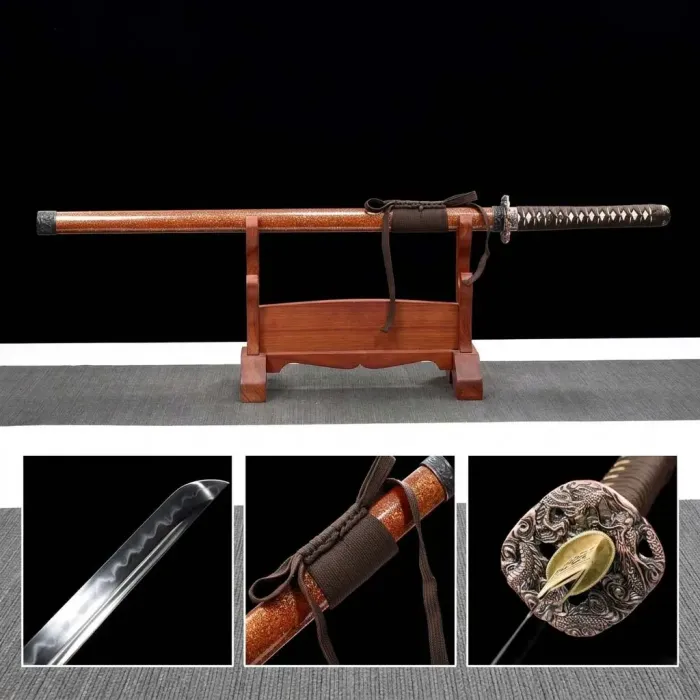
The classic katana remains a exquisite work of art, but say you need to manifest your distinct design? Modifying your cutting tool is a deep journey, allowing you to construct a truly matchless piece. From the hilt wrapping and binding to the guard design and heat mark, each aspect offers a chance for tailored look. This investigation delves into the sphere of katana refinements, providing details for both initiates and experienced enthusiasts wanting to establish their stamp on the traditional art of the samurai.
Freshman's True Artistry
For learners motivated to embark on the exciting journey of eastern weapon training , 1060 steel katanas present an ideal entry point. This defined grade of essential steel strikes a nice compromise between expense and excellence . While lacking compared to hard as premium steels, 1060 permits a suitable level of cutting preparation , making it beneficial for beginners to practice the core principles of weapon preservation and embrace the appeal of artisanal Japanese weaponry. It’s a outstanding choice for cultivating experience without the pecuniary burden of more advanced steels.
T10 Steel Katanas : Finding Quality and Price
To help hobbyists seeking an authentic sword experience without exceeding the bank , T10 steel katanas represent a promising option. These implements offer a considerable improvement in lastingness compared to inferior alternatives, exhibiting sufficient edge retention and ample flexibility for elementary cleaving techniques. While not rivaling the premium characteristics of more refined steels like T100 or folded compound, T10 provides a admirable blend of effectiveness and economy , making them a favored choice for newcomers and those on a limited resources .
Overcoming the Cutting Surface : Modifying Your Katana's Attachments and Haft
Despite the honed sharpened metal is undeniably the focal point of a katana, truly heightening its elegance lies in the cautious customization of its fittings and grasp . This procedure allows enthusiasts to manifest their one-of-a-kind taste . Weigh the broad possibilities: menuki - decorative appliqués that bring visual appeal ; the hamon sheaths – often masterfully etched ; the tsuka nucleus itself, wrapped in classic ito rope ; and the fusa butt cap , which can be fabricated from various elements like treasures or ivory .
- Prefer concepts that resonate with you.
- Explore with different ingredients .
- Prioritize superiority for a lasting influence .
The Fascination of the Katana: Origins, Mastery, and Material
Each nihonto exhibits a unique allure, steeped in generations of Asian history and tradition . More than merely a instrument of hostilities , it's a symbol of the fighter ethos – a fusion of ability and rule. Its progression spanned various generations, with early arms evolving into the elegant curvature and fatal edge we distinguish today. The construction involved is truly extraordinary , requiring long periods of instruction to complete. The process involves a intricate folding of refined metal , creating layers that reinforce the instrument’s flexibility and cutting ability. Multiple schools of blacksmithing appeared , each with their special secrets and techniques for achieving the ultimate poise and acuteness - a truly grueling pursuit.
- First Katana classes
- The importance of the traditional blade in samurai culture
- Traditional forging processes
Picking the Appropriate Steel for Your Bladed Weapon Project: 1060 vs. T10
Opting for the ideal steel is vitally important for any cutting weapon project, and the determination between 1060 and T10 can be difficult. 1060 is a favored American material, offering a acceptable balance of durability and robustness, providing it fairly easy to temper. However, T10, a Japanese steel, generally boasts exceptional wear permanence and can may achieve a superior definitive hardness, although it can be markedly challenging to handle and requires precise heat refinement. Consider your qualification and expected effects: for a first-timer, 1060 may be a easier origin, while the expert smith might value the supplementary qualities of T10.
- Ease of Operating
- Resistance
- Conclusive Durability
Realizing the Capability: Sophisticated Katana Tuning Practices
Perfecting the skill of sword tuning extends far beyond basic whetting. Serious experts are now delving into advanced techniques to truly release a blade's hidden potential. This features intricate work with the temper line, utilizing specialized resources for differential strengthening and carefully selecting the configuration of the guard to optimize balance and performance. Beyond purely functional refinements, artisans are increasingly focused on creating unparalleled aesthetic magnificence, through complex carving and layered varnishes that truly transform a katana into a magnum opus.
Shaping Rough Steel into Perfection: Making a 1060 Sword
The journey begins with average 1060 metal , a hard material far from the sophisticated katana it will become . Adept bladesmiths employ a elaborate process of uniting and crafting the primary steel, repeatedly raising it and impacting it to remove impurities and generate a stable grain structure. This painstaking process, often spanning for days , builds the t10 steel katana required force and pliability characteristic of a bona fide Japanese edge . Additional heat applications , including careful hardening and annealing , are necessary to achieve the aimed balance of sharpness, endurance and loveliness .- Uniting: Removes impurities and develops grain structure.
- Forming: Fabricates the steel into the initial blade form.
- Tempering: Decides the final hardness and flexibility.
The Perpetual Attraction of the Katana: Extensive Study of Steel and Alteration
That time-honored katana survives a powerful symbol for Japanese tradition , its attraction far overtopping mere arms and armor . Forged from traditional steel and often featuring intricate patterns , the method of creation itself is a respected art. Beyond the core craftsmanship, the ability to tailor a katana - from the quench mark to the haft wrapping and fitting - affords for a sincerely individual demonstration for both worshippers and followers alike. This amalgamation of classical steelwork and boundless personalization creates the katana's continued widespread acceptance across the realm .